What Environmental Standards Do DOING Pyrolysis Plants Meet? Are They Equipped With CEMS?
Date:2026-07-08 15:39:12 Industry Trends /Give me the price / Leave a message- Skype: bonniezhao2
- Tel: 008613526692320
- Whatsapp/Cel: +8613526692320
- Email: market@doinggroup.com
When a customer invests in a waste tire or plastic pyrolysis plant, one of the first questions that comes up is whether the equipment will meet local environmental regulations. Emission rules differ widely — what satisfies a permit in one country may fall short in another. At DOING, we build our pyrolysis systems with this variation in mind, so customers can get a plant configured for their specific regulatory environment.
This article breaks down how DOING pyrolysis plants handle emissions, what pollution indicators they control, which environmental certifications our equipment carries, and whether CEMS is available as an option.
Environmental Protection Facilities Built into DOING Pyrolysis Plants
DOING pyrolysis plants come with a comprehensive set of environmental protection devices to address the byproducts generated during the pyrolysis process. These facilities handle the flue gas and syngas produced from thermal decomposition, ensuring that emissions remain within permissible limits before they are released into the atmosphere.
Exhaust Gas Purification System
The exhaust gas purification system handles the gases produced throughout the pyrolysis process in a staged manner. Non-condensable syngas generated during pyrolysis first passes through the exhaust gas purification stage, where impurities and volatile compounds are removed before the cleaned gas is circulated back to the reactor as supplementary fuel — this closed-loop reuse suppresses VOC emissions at the source. Any syngas that cannot be recirculated is directed to a secondary combustion chamber, where it is burned off completely. The flue gas resulting from this combustion then moves through subsequent treatment stages: a pulse dust collector captures particulate matter, followed by a desulfurization tower that removes sulfur dioxide through wet scrubbing, and an SCR denitration device that reduces nitrogen oxide emissions. Each stage brings the final stack emissions closer to the standards required at the project site. This multi-stage approach handles the complex gas composition produced during tire and plastic pyrolysis and ensures that all four regulated pollution indicators are addressed before the gas exits the stack.
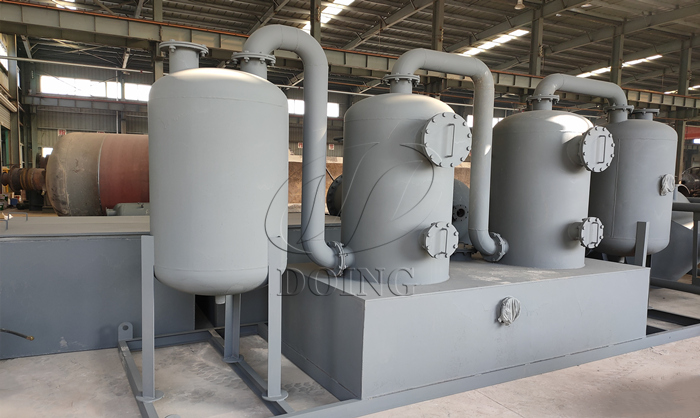
DOING pyrolysis plant exhaust purification device
Pulse Dust Collector
A pulse dust collector is installed to capture fine particulate matter from the flue gas stream. Unlike conventional filtration methods, the pulse jet system uses high-frequency bursts of compressed air to automatically clean the filter bags, maintaining consistent collection efficiency over extended operating periods without interrupting the process. Particulate matter — one of the four key pollution indicators in pyrolysis projects — is physically separated from the gas stream and collected in a dedicated ash hopper for disposal or further processing. The pulse dust collector is designed to handle the high dust loads typical of pyrolysis operations while keeping maintenance requirements low.
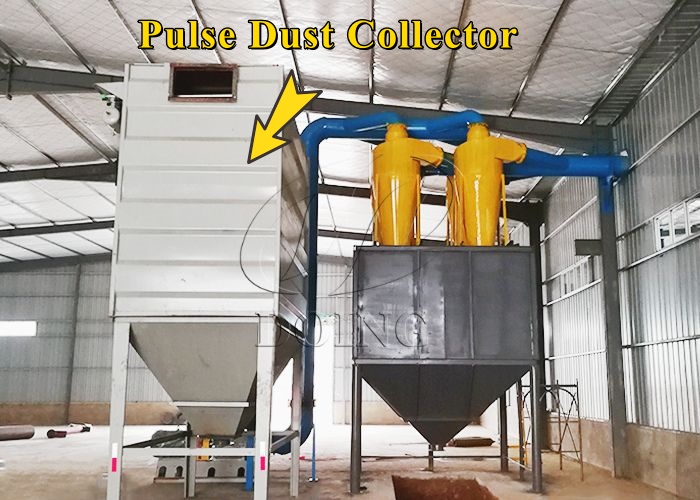
DOING pyrolysis plant pulse dust collector
Desulfurization Tower
The desulfurization tower addresses sulfur dioxide (SO2) emissions, one of the most common acidic pollutants produced during the combustion of pyrolysis-derived fuels. Also known as a wet scrubbing tower, it employs a chemical absorption process where the flue gas contacts an alkaline solution — typically lime or sodium-based reagents — that reacts with and absorbs SO2 compounds. DOING’s desulfurization equipment achieves a sulfur removal efficiency exceeding 90%, bringing SO2 levels well below the thresholds set by most international environmental standards. The treated gas exiting the tower is significantly cleaner and cooler, making it easier to handle in any downstream treatment stages.
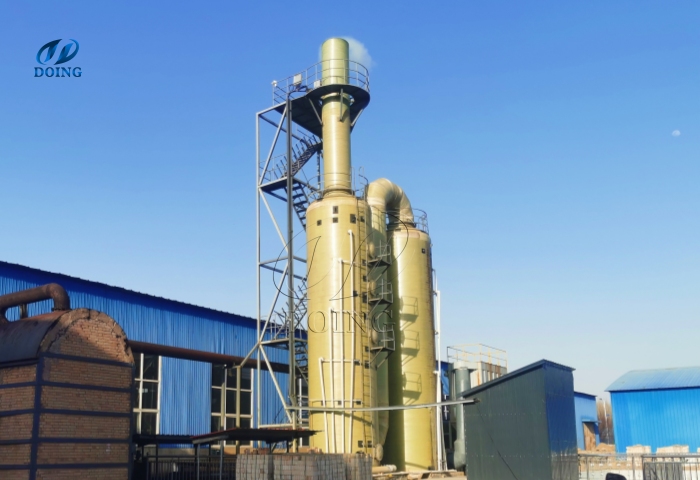
Desulfurization tower to addresse sulfur dioxide (SO2) emissions
SCR Denitration Device
For the control of nitrogen oxides (NOx), DOING pyrolysis plants can be equipped with Selective Catalytic Reduction (SCR) denitration devices. NOx compounds form during high-temperature combustion stages and are subject to strict limits in most regulatory frameworks. The SCR system injects a reductant — into the flue gas stream, which then passes over a catalyst surface. This selectively converts NOx into harmless nitrogen gas (N2) and water vapor (H2O). DOING offers different SCR configurations with varying denitration efficiencies, allowing the system to be matched to the specific NOx limits applicable in the customer’s region.
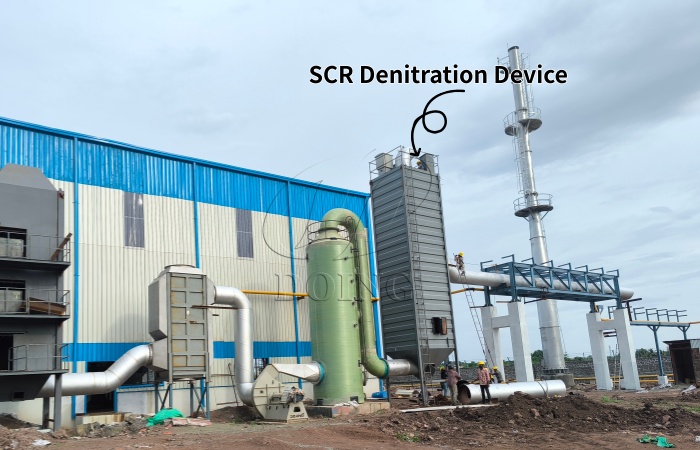
SCR denitration device to control nitrogen oxides (NOx)
The Four Pollution Indicators
Every waste tire and plastic pyrolysis project must address four primary pollution indicators: sulfur dioxide (SO2), nitrogen oxides (NOx), particulate matter, and volatile organic compounds (VOCs, also referred to as non-methane total hydrocarbons). DOING provides targeted solutions for each of these, configurable based on the emission standards that apply to the customer’s location.
| Pollution Indicator | Source in Pyrolysis | DOING’s Control Solution | Efficiency |
| SO2(Sulfur Dioxide) | Combustion of sulfur-containing materials | Desulfurization tower with wet scrubbing | >90% removal |
| NOx(Nitrogen Oxides) | High-temperature combustion in the heating system | SCR denitration device | Configurable per standard |
| Particulate Matter | Incomplete separation during gas treatment | Pulse dust collector with automatic jet cleaning | High efficiency filtration |
| VOCs(Non-methane Total Hydrocarbons) | Volatile compounds released during pyrolysis | Exhaust gas purification + activated carbon adsorption | Adsorption and neutralization |
For areas with stricter emission limits, DOING can combine multiple treatment stages into a single integrated system, ensuring that all four indicators meet the required standards simultaneously. We always recommend that customers share the specific emission standards applicable to their project site so we can configure the air emission control system accordingly.
Certifications Held by DOING Pyrolysis Plants
DOING pyrolysis plants have obtained recognized international certifications to verify their environmental and quality performance. These certifications are achieved through third-party testing and audit, providing objective evidence of compliance with established standards.
CE Certification: Confirms that our pyrolysis plant meets the essential health, safety, and environmental protection requirements applicable within the European Economic Area.
ISO Certification: DOING maintains ISO quality management and environmental management system certifications, demonstrating consistent processes in manufacturing and environmental compliance.
SGS Certification: SGS testing and inspection services have been used to verify our equipment performance, including emission levels and processing capacity claims.
These certifications apply across DOING’s range of pyrolysis plant, from small-scale 100kg–3 ton daily capacity units to large industrial-scale systems operating at 20–50 tons per day. It is worth noting that emissions from the smaller 100kg–3 ton batch plants are comparatively minimal and may fall below thresholds that require extensive treatment in certain jurisdictions. Normal-scale plants in the 5–20 ton range typically require an exhaust gas purification system and a desulfurization tower, whereas large-scale plants in the 30–50 ton range generally require the full suite of emission control equipment described above.
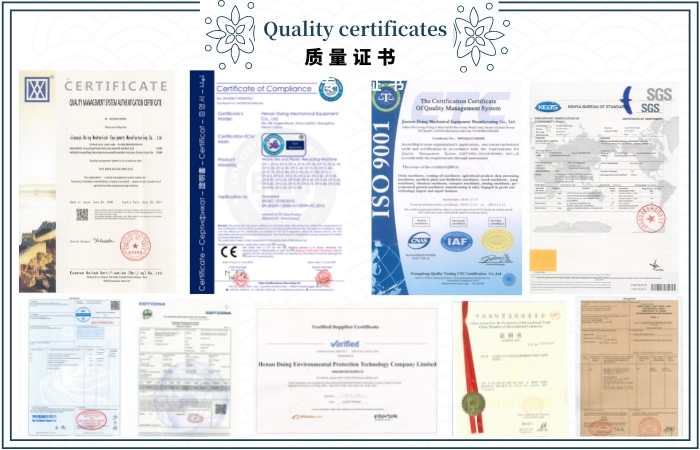
DOING pyrolysis plant quality certificates
Are DOING pyrolysis plants equipped with CEMS?
DOING pyrolysis plants can be equipped with a CEMS (Continuous Emission Monitoring System) to provide real-time, automated tracking of flue gas composition including SO2, NOx, particulate matter, and oxygen content and flow rates. This recorded data can be presented to regulatory bodies to demonstrate compliance over time. For customers operating in regions where CEMS is not yet mandatory, adding this system provides proactive transparency and can streamline permitting processes. Our pyrolysis plant has flue gas test reports prepared by a professional testing company. If you need them, please contact us to obtain them.
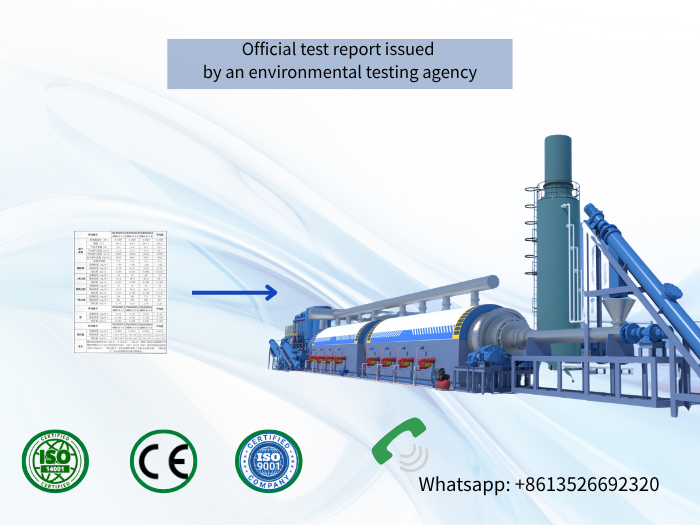
DOING pyrolysis plant certified by professional institutions
Emission Standards by Region
Emission standards for pyrolysis facilities differ from country to country, and they also vary between general industrial zones and heavy industrial zones within the same country.
Because these standards continue to tighten year by year, DOING has maintained active research and development in emission control technology over the past decade. Our current portfolio of patented environmental protection devices enables our pyrolysis plants to achieve emission levels that satisfy both Chinese and European regulatory requirements.
When you inquire about a DOING pyrolysis plant, sharing the specific emission standards applicable to your project site allows our team to recommend the most appropriate configuration for your air emission control system — avoiding both under-specification and unnecessary over-engineering.