The Respective Advantages of Fully Continuous and Semi-Continuous Pyrolysis Equipment
Date:2026-05-21 11:14:57 Industry Trends /Give me the price / Leave a message- Skype: bonniezhao2
- Tel: 008613526692320
- Whatsapp/Cel: +8613526692320
- Email: market@doinggroup.com
Entering the waste tire, plastic or oil sludge pyrolysis industry requires careful planning, and one of the most important decisions you will face is choosing the right type of pyrolysis systems. Continuous pyrolysis equipment is now becoming increasingly popular, thanks to its high efficiency, low per-unit waste treatment costs, strong environmental compliance, and alignment with relevant policies.
As a reliable manufacturer, Doing Group offers two continuous pyrolysis process options: both fully continuous and semi-continuous pyrolysis solutions to choose from. We have helped clients in more than 100 countries and regions around the world select the right pyrolysis equipment based on their specific needs. Each system has its own strengths.
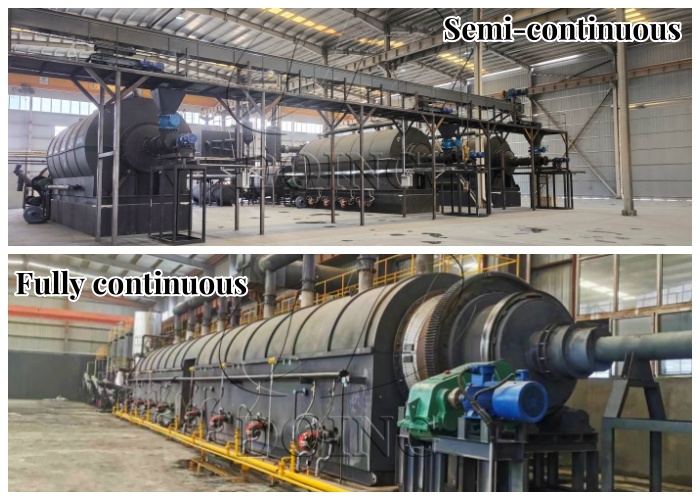
DOING semi-continuous pyrolysis equipment and fully continuous pyrolysis equipment
Fully Continuous Pyrolysis Equipment
Fully continuous pyrolysis equipment is designed for large-scale, high-efficiency operations. It allows the reactor to run without interruption for extended periods, typically up to 40 days or more. Equipped with continuous feeding and discharge system that eliminates the need for daily cooling, unloading, and reheating.
1. Higher Production Efficiency and Output
In a fully continuous pyrolysis equipment, the reactor stays hot throughout the process. Material is fed in one end, and products are discharged at the other end without stopping. This design significantly increases throughput. Daily processing capacities typically range from 15 to 50 tons, making fully continuous pyrolysis equipment ideal for large-scale operations.
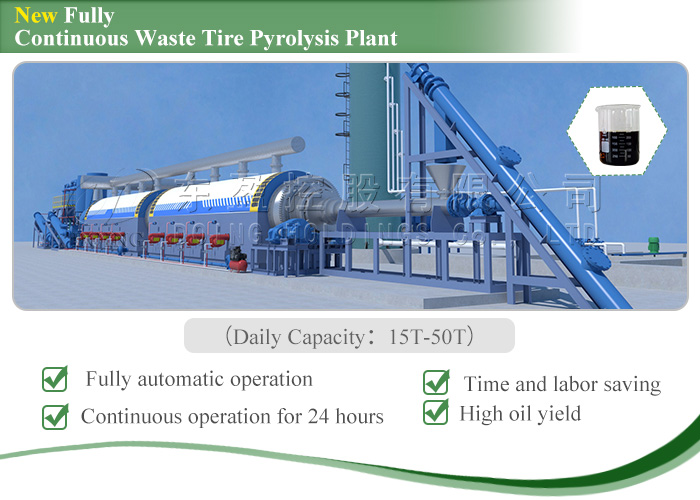
Characteristics of DOING fully continuous pyrolysis equipment
2. Improved Energy Efficiency and Environmental Performance
Because the reactor never cools down, there is no need to repeatedly heat it from a cold state. This reduces fuel consumption and lowers operating costs. The fully continuous pyrolysis equipment features a fully enclosed, automated design and a PLC control system manages the entire process, helping to prevent gas leaks and maintain stable operation. Furthermore, it is equipped with environmental protection facilities such as SCR denitrification and desulfurization towers to ensure compliance with stringent environmental regulations.
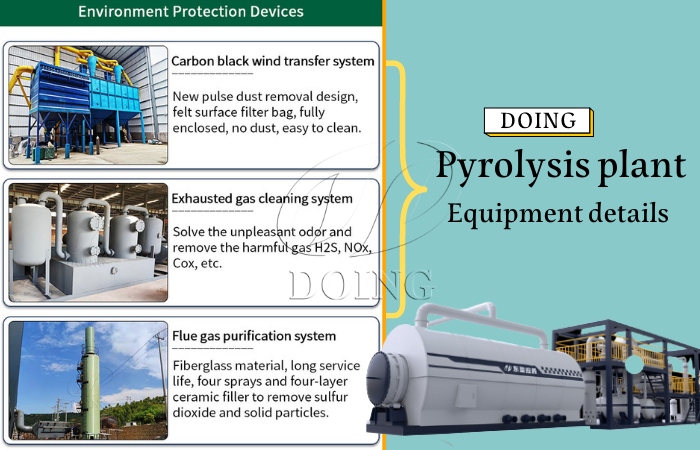
DOING pyrolysis equipment environment protection devices
3. Consistent Product Quality
Continuous operation allows for stable temperature control and uniform material residence time. This consistency directly affects the quality of the end products—pyrolysis oil, carbon black. When operating conditions remain steady, the output is more uniform and reliable. This can improve the market value of your products and increase the return on your investment.
4. Important Considerations
While fully continuous pyrolysis equipment offers clear advantages, it also has specific requirements. The feedstock must be pre-treated before entering the reactor. Whole tires or large, irregularly shaped items cannot be fed directly. Instead, the material should be in the form of powders, small granules, or small, uniform pieces. The actual processing capacity also depends on factors such as feedstock density, moisture content, oil content, and the tendency of the material to agglomerate.
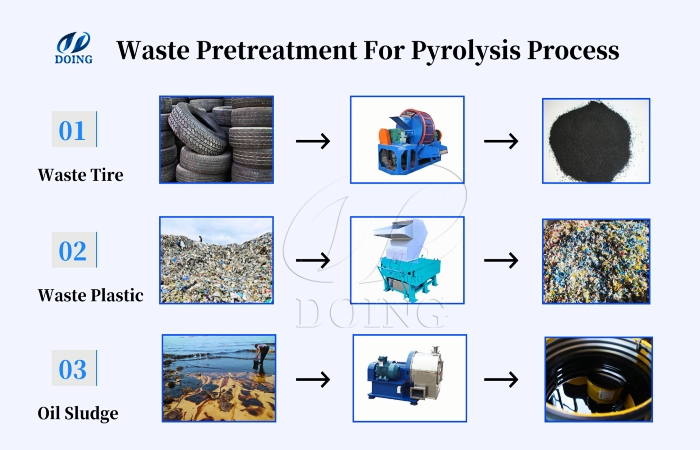
DOING fully continuous pyrolysis equipment pretreatment
In addition, the initial investment for fully continuous equipment is higher. The reactor and supporting systems—including sealing mechanisms at the feed and discharge ends, anti-coking systems, and anti-clogging systems in the pipes—must meet high engineering standards. These components are essential for smooth, uninterrupted operation. If your feedstock supply is stable, pre-processed, and available in large volumes, a fully continuous system can be a very cost-effective long-term solution.
Who is it for?
Medium to large-scale operators with a steady supply of pre-treated feedstock
Investors who prioritize high output, energy efficiency, and consistent product quality
Users who are prepared to make a higher initial investment in exchange for lower long-term operating costs
Semi-Continuous Pyrolysis Equipment
Semi-continuous pyrolysis equipment offers a more flexible and accessible option for many operators. It combines some of the advantages of continuous operation with a simpler design and lower upfront cost.
1. Lower Initial Investment
Semi-continuous pyrolysis equipment has a simpler structure with fewer moving parts and auxiliary components. This makes them more affordable, especially for small and medium-sized enterprises or first-time investors. The lower capital requirement reduces the financial risk and allows operators to start their projects with a smaller budget.
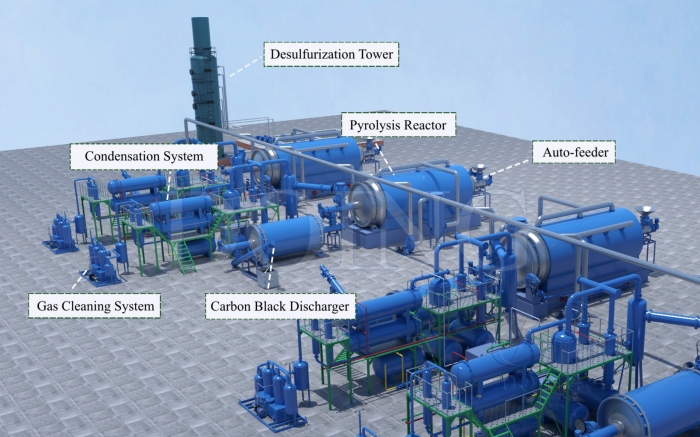
DOING semi-continuous pyrolysis equipment composition
2. Easier Operation and Maintenance
The automation and sealing systems in semi-continuous pyrolysis equipment are less complex than those in fully continuous systems. This means the technical demands on operators are lower. Training new staff is easier and faster. This is a significant advantage for operators who want a reliable system that does not require highly specialized personnel.
3. A Practical Balance Between Cost and Efficiency
Although semi-continuous pyrolysis equipment can finish three batches of waste to fuel pyrolysis process in two days. The reactor does not need to cool down completely, and the feeding and discharge process is more efficient than in fully manual batch pyrolysis plants. Typical daily processing capacities range from 5 to 20 tons. This makes semi-continuous equipment a practical and cost-effective choice for many operators.
4. Feedstock Flexibility with Moderate Pre-Treatment Requirements
Semi-continuous systems still require some feedstock pre-treatment, but the requirements are not as strict as those for fully continuous equipment. This gives operators more flexibility in sourcing and preparing raw materials.
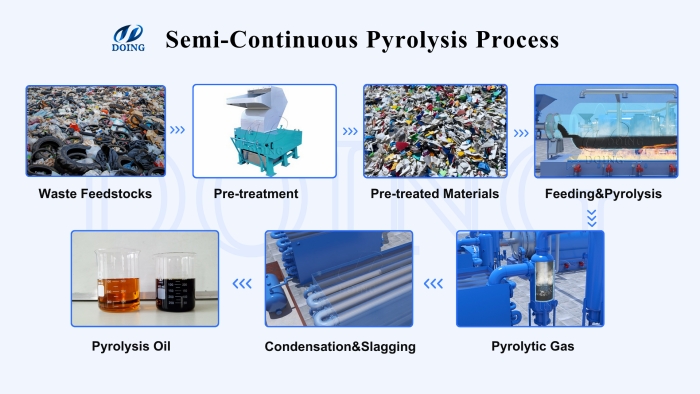
DOING semi-continuous pyrolysis equipment process
Who is it for?
Small to medium-scale operators with limited budgets
First-time investors looking for a simpler, lower-risk entry into the pyrolysis industry
Users who value ease of operation, lower maintenance demands, and practical efficiency
Choosing between fully continuous and semi-continuous pyrolysis equipment depends on your specific situation. Consider the type and volume of feedstock you have, your budget, your technical capabilities, and your production goals.
If you have a stable, high-volume supply of pre-processed material and are looking for maximum output and efficiency, a fully continuous pyrolysis equipment may be the right choice. On the other hand, if you want a more affordable, easy-to-operate system that still delivers good production capacity, a semi-continuous pyrolysis equipment could be a better fit.
At DOING Group, our team can help you evaluate your options and choose the solution that best meets your needs. If you are interested in learning more, please contact us. We are here to support you in your pyrolysis journey.