What Equipment Can Produce HFO?
Date:2026-04-24 17:06:01 Industry Trends /Give me the price / Leave a message- Skype: bonniezhao2
- Tel: 008613526692320
- Whatsapp/Cel: +8613526692320
- Email: market@doinggroup.com
Globally, industries spanning steel manufacturing, boiler heating, and power generation maintain a consistent demand for heavy fuel oil (HFO). However, reliance on virgin fossil fuels presents significant challenges, including volatile costs and increasing pressure to reduce carbon emissions. A sustainable and economically viable solution is emerging: pyrolysis technology. These industrial pyrolysis equiopments are engineered to transform various waste streams into high-value products: heavy fuel oil (HFO), carbon black, and combustible gases.
How Pyrolysis Equipments Produce HFO
Pyrolysis process involves subjecting organic materials to high temperatures within an oxygen-free environment. This crucial lack of oxygen prevents combustion, instead promoting thermal cracking, where the long-chain polymer molecules found in various organic waste are broken down into shorter-chain hydrocarbons. The ultimate outcome is a fuel oil with properties highly comparable to industrial-grade heavy fuel oil (HFO) or furnace oil.
DOING Group specializes in the manufacturing and supply of precisely this type of advanced pyrolysis equipment. The pyrolysis equipments are meticulously engineered to process a wide variety of waste feedstocks into heavy fuel oil, including:
Tires & Rubber: This includes whole tires (car, truck, construction machinery), rubber cable sheaths, shoe soles, rubber sheets, and other unsorted rubber products.
Plastics: Capable of handling pure plastics like PP, PE, PS, and ABS, as well as mixed or contaminated plastics that are typically challenging to recycle through traditional mechanical methods, such as mixed plastic, medical plastic waste, agricualture plastic films.
Oil Sludge: This category covers diverse industrial wastes such as steel plant sludge, tank bottom sludge, oil-based rock cuttings, and drilling sludge.
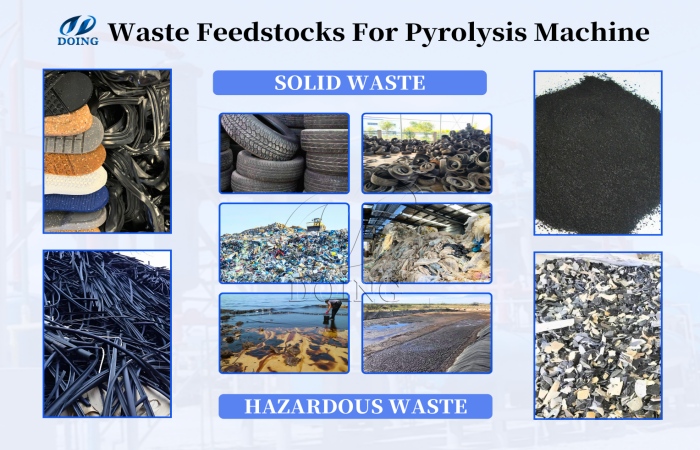
Waste feedstocks for pyrolysis equipment
DOING Group's Waste to Fuel Oil Pyrolysis Equipment
Depending on your specific processing capacity needs, operational budget, and site constraints, DOING Group offers four distinct pyrolysis equipment configurations for heavy fuel oil production: frame type, batch-type, semi-continuous type, and fully continuous type.
1. Frame-Type Pyrolysis Equipment
The "frame type" system represents a compact, modular design where key components—such as the pyrolysis reactor, condenser, and flue gas purification system—are pre-integrated within a robust steel frame.
This design offers batch capacities typically ranging from 100kg to 500kg.
This configuration facilitates easy transportation, rapid installation, and quick on-site deployment, requiring minimal floor space. It offers high flexibility and mobility, making it ideal for pyrolysis experiments, pilot projects, or operations with limited available space.
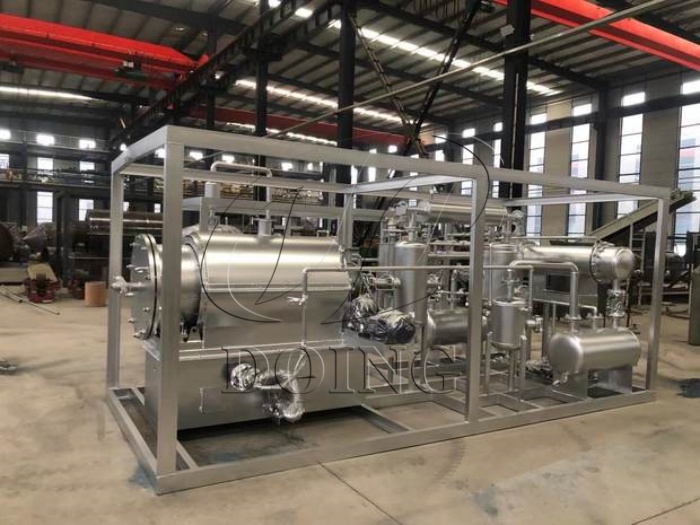
DOING small scale frame type pyrolysis equipment
2. Batch-Type Pyrolysis Equipment
Batch pyrolysis equipment is the most straightforward and widely adopted configuration. It processes material one batch at a time, completing an entire cycle before the next batch can begin. This cycle includes feeding, sealing, heating, pyrolysis, cooling, product discharge, and finally, restarting the process.
Processing Capacity: Typically handles 1 to 15 tons per batch.
Its simple structure leads to a lower initial investment cost. It offers flexible operation, making it suitable for small-scale operations and processing multiple varieties of waste, such as mixed plastics.
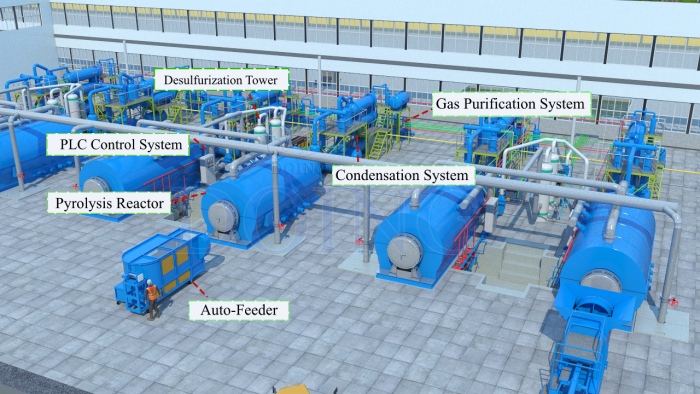
DOING batch type pyrolysis equipment composition
3. Semi-Continuous Pyrolysis Equipment
Semi-continuous pyrolysis equipment strikes a balance between batch and fully continuous types, achieving partially continuous operation. This typically means the pyrolysis reactor can maintain high-temperature operation for extended periods, allowing for continuous feeding and slag discharge without cooling down the reactor completely between batches. DOING Group's semi-continuous systems can process approximately three batches every two days.
Processing Capacity: Capable of handling 5 to 20 tons per day.
This type offers higher throughput than batch type pyrolysis equipment, improved process stability, and a relatively higher level of automation, which helps reduce labor costs. It is well-suited for medium-scale production facilities.
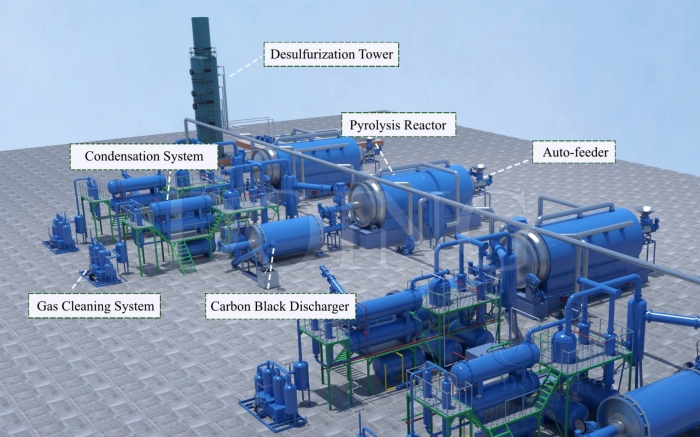
DOING semi-continuous type pyrolysis equipment composition
4. Fully Continuous Pyrolysis Equipment
Fully continuous pyrolysis equipment is the most efficient and highly automated type. Raw materials are fed continuously into the reactor at a consistent rate, the pyrolysis process proceeds without interruption, and all resulting products (pyrolysis oil, non-condensable gas, and carbon black) are discharged continuously.
Processing Capacity: Designed for high volumes, typically 30 to 50 tons per day.
The fully continuous pyrolysis equipment can operate 24 hours a day for extended periods, often up to 40 days without interruption, demonstrating exceptionally high production efficiency and excellent energy utilization. It yields consistent product quality, making it ideal for large-scale industrial production. But this configuration involves the highest initial investment and more stringent requirements for raw material uniformity to ensure smooth, continuous operation.
The profitability of an HFO production plant is directly linked to two critical factors: the quantity of oil extracted from waste and the operational costs. DOING Group's pyrolysis equipments are engineered to excel in both areas.
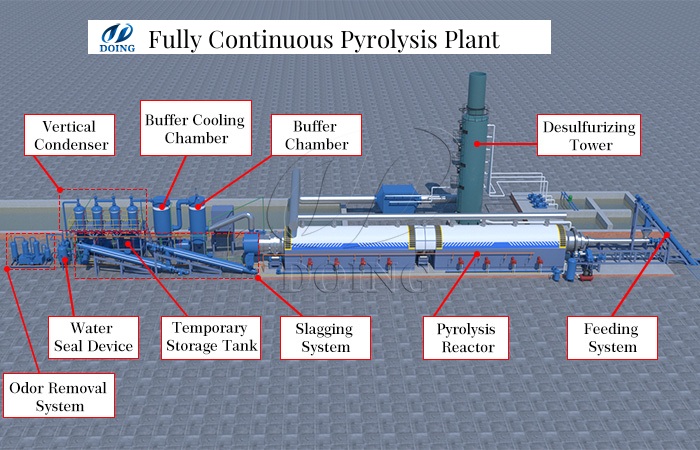
DOING fully continuous type pyrolysis equipment composition
Maximizing HFO Yield From Waste Pyrolysis Process:
①Rubber Materials: Generally range from 30% to 52%.
Large automobile, truck, and construction machinery tires often yield 45%-52%.
Smaller car/motorcycle tires, rubber cable sheaths, and assorted rubber products typically achieve 35%-40%.
Rubber sheets and carpets tend to have an oil yield of around 30%.
②Plastic Materials: Oil yields can vary widely, from 15% to 95%.
Pure PP, PE, and PS plastics boast the highest yields, reaching 80%-90%.
Pure ABS plastics, food packaging bags, and aluminum-plastic composites typically yield around 40%-50%.
For mixed plastic waste, such as plastic household waste and paper mill waste, the oil yield fluctuates significantly, ranging from 15% to 50%.
③Oily Sludge Materials: Oil yield typically ranges from 15% to 70%.
The oil yield of oil sludge can fluctuate greatly, from 15% to 70%, depending on its composition and oil content.
Oil sands and coal tar residues show a more stable oil yield, typically about 20% to 30%.
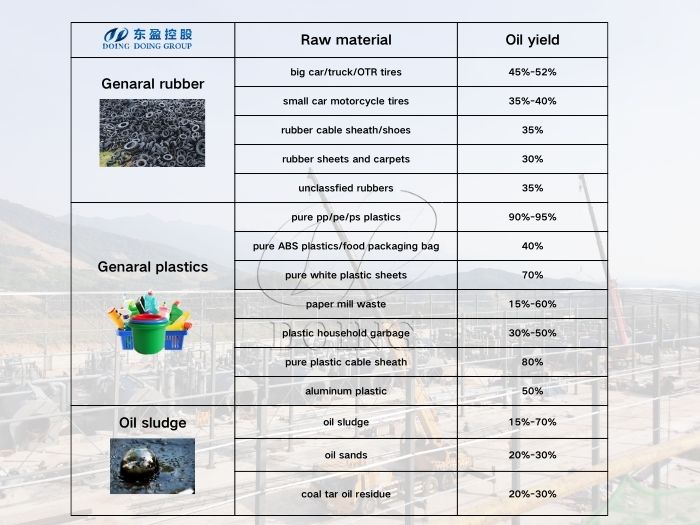
DOING pyrolysis equipment feedstocks and their pyrolysis oil yield
Combustible Gas Recycling:
Heating the reactor is often a major operational expense in the waste to fuel oil pyrolysis process. DOING Group's systems are designed to mitigate this cost through combustible gas recovery.
During the pyrolysis process, approximately 10% of the output consists of non-condensable combustible gases, also known as syngas. Rather than flaring off or wasting these gases, DOING Group's pyrolysis equipments redirect them back into the reactor's heating chamber to serve as a supplementary fuel source. This design dramatically reduces the consumption of external fuels (such as coal, wood, or diesel) required to maintain the reactor's temperature. This directly translates into lower operational costs, improved energy efficiency, and a reduced carbon footprint for your facility.
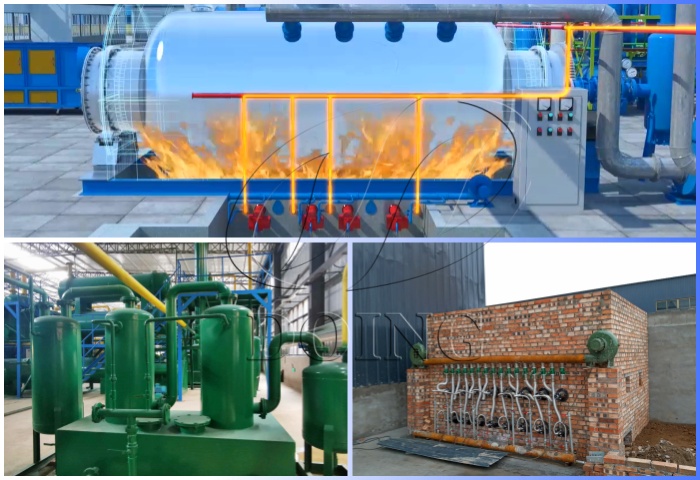
DOING pyrolysis equipment combustible gas recycling system
If you are interested in producing HFO-type oils through pyrolysis equipment, exploring waste to fuel conversion, or wish to understand the pyrolysis technical specifications and potential profitability for your specific waste, please do not hesitate to contact DOING Group. Our experts can provide detailed technical proposals, competitive quotations, and assist with oil yield testing for your materials.