What is pyrolysis plant and what are the applications of pyrolysis plant?
Date:2020-07-29 17:57:33 Pyrolysis machine FAQ /Give me the price / Leave a message- Skype: bonniezhao2
- Tel: 008613526692320
- Whatsapp/Cel: +8613526692320
- Email: market@doinggroup.com
As the global community intensifies its focus on the circular economy and sustainable waste management, traditional disposal methods like landfilling and primitive incineration are rapidly being phased out. Among the most promising technological breakthroughs in this domain is the pyrolysis plant.
 Pyrolysis plant as waste to fuel recycling machine
1. What is a Pyrolysis Plant?
As the name suggests, pyrolysisplant is a mechanical equipment that works according to the principle ofpyrolysis technology. A pyrolysis plant is an industrial recyclingsystem designed to thermally decompose macromolecular organic wastes. Atpresent, it is popular to use pyrolysis plant to treat some wastes,such as waste tires, scrap rubber, waste plastics, oil sludge, aluminumplastic materials, medical plastic materials, biomass, etc., so as torealize the regeneration and utilization of resources.
Under thecondition of high temperature without oxygen, the large molecules inwaste tires, waste plastics and oil sludge will break into smallmolecules of oil gas, which will form liquid oil after condensation.Besides fuel oil, by-products like carbon black, biochar, syn-gas, steelwire, etc. will be recovered from pyrolysis plant.
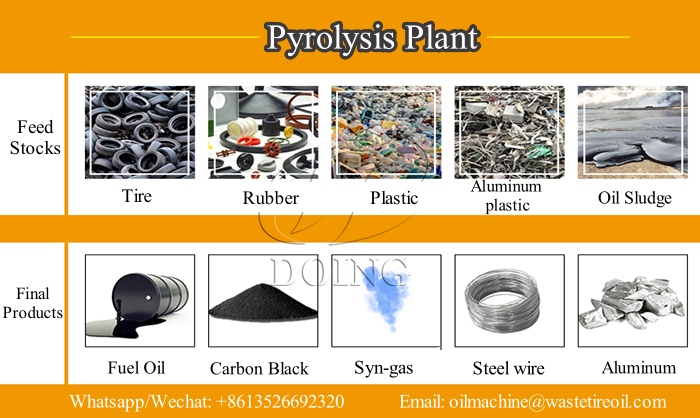 Pyrolysis plant feedstocks and final products
2. Components of pyrolysis plant
Acomplete production line of pyrolysis plant is mainly composed of rawmaterial pre-treatment machine(like tire crusher, tire shredder, tire torubber powder processing machine, plastic shredder), auto-feeder,pyrolysis reactor, condensing system, oil tank, tail gas cleaning andodor removal system, control cabinet, carbon black discharge device,smoke cleaning system, desulfurization & purification tower, etc.
 Components of pyrolysis plant
3. Technical Working Principle of Pyrolysis
Unlikedirect combustion, pyrolysis is an endothermic cracking processoperating below the burning threshold of the input materials.Itrepresents a highly eco-friendly alternative for solid waste matrixdestruction and resource recovery.
A pyrolysis plant thermallydecompose macromolecular organic wastes into high-value sub-products(pyrolysis oil, biochar, carbon black, and combustible gas) in anoxygen-free or oxygen-deficient environment. The industrial pyrolysisprocess relies on precise temperature control and multi-stagecondensation.
 Working process of pyrolysis plant
The thermodynamic and chemical sequence of Pyrolysis Process is executed as follows:
①Feedingand Pre-treatment: Raw materials (e.g., waste tyres or sorted plastics)are automatically conveyed into the hermetically sealed pyrolysisreactor. For continuous pyrolysis plants, tyres must be shredded into15–25mm chips beforehand to optimize thermal efficiency.
②ThermalCracking (Heating): The reactor is heated using fuel, natural gas, orliquefied petroleum gas (LPG). As the inner temperature reaches 200°C -350°C, the macromolecular polymers begin to fracture, generating oil gas(vaporized hydrocarbons).
③Fractional Condensation: The generatedoil gas flows through a multi-stage cooling system. Heavy oil gas dropsinto the sludge tank, while light oil gas enters high-efficiency tubularcondensers. Here, it cools down and liquefies into pyrolysis oil (fueloil).
④Gas Recycling: The non-condensable but combustible gas(syngas) is routed through a safety water seal system and redirectedback to the reactor's furnace to serve as heating fuel. This closed-loopdesign minimizes external energy consumption.
⑤Discharging: Afterthe cracking process is complete, the temperature drops, and the solidresidue—mainly carbon black and steel wires (for tyres)—is dischargedsafely via an enclosed, water-cooled automatic discharging system toprevent dust pollution.
⑥Exhaust Gas Treatment: Following thecompletion of the core pyrolysis process, DOING pyrolysis solutionsubjects the smoke gas and exhaust gases generated during heating topurification treatments—such as desulfurization, denitrification,photo-oxidation, and electrolysis—ensuring compliance with environmentalregulations across various regions, including the stringent standardsof Europe and the United States.
Check the overall introduction and display video of DOING Pyrolysis Plant Working Process:
4. Three Types of Pyrolysis Plants For Sale
Tohelp investors choose the optimal configuration based on budget,throughput requirements, and local labor costs, the table belowdelineates the core operational differences between the three primarypyrolysis reactor designs:As the name suggests, pyrolysis plantis a mechanical equipment that works according to the principle ofpyrolysis technology. At present, it is popular to use pyrolysis plantto treat some wastes, such as waste tires, waste plastics, oil sludge,etc., so as to realize the regeneration and utilization of resources.
| Operational Metrics | Batch Type Pyrolysis | Semi-Automatic Pyrolysis | Fully Continuous Pyrolysis |
| Raw Material Pre-treatment | Accepts whole tyres, minimal pre-shredding required | Requires shredding (15-25mm) and wire removal | Requires strict shredding (<20mm) and wire removal |
| Feeding &Discharging Mode | Intermittent, discharge batch by batch, more cooling time | Auto-feed and high temperature discharge | Simultaneous feeding and discharging |
| Working Efficiency | 1 batch per day | 3 batches in 2 days | 24/7 uninterrupted operation |
| Daily Processing Capacity | DY-100KG, DY-500KG, DY-1TON, DY-2TON, DY-5TON, DY-10TON, DY-12TON, DY-15TON | DY-S-5TON, DY-S-10TON, DY-S-15TON, DY-S-18TON, DY-S-20TON | DY-C-15TON, DY-C-20TON, DY-C-30TON, DY-C-40TON, DY-C-50TON |
| Automation & Labor Cost | Requires manual supervision during cycling; high labor. | Higher automation degree | PLC computerized control; minimal manual intervention |
5. High-Value End Products and Industrial Applications
One of the most frequent questions from potential investors is: "What is the actual oil yield of a pyrolysis plant?" The truth is that oil yield depends heavily on the type and quality of the feedstocks injected into the pyrolysis plant. Below is a detailed breakdown of diverse raw material oil yields and other end-product characteristics. Each of these products features substantial commercial and industrial applications:
A. Pyrolysis Fuel Oil (40% - 45% Yield)
Pyrolysis oil is a premium heavy fuel substitute characterized by a high calorific value (Q ≥ 40 - 43 MJ/kg). It is widely used as a direct heating source in heavy industries, including steel factories, cement plants, boiler heating systems, and glass manufacturing units. Furthermore, it can be refined into non-standard diesel using a waste oil distillation plant for use in agricultural machinery or generators.
 Pyrolysis oil applications
Waste feedstocks for modern thermal pyrolysis plant are versatile. The table below provides an engineering baseline for typical oil yields across various feedstocks:
| Raw Material Type | Average Oil Yield (%) | Primary Solid Residue & Characteristics |
| Big Truck Tyres | 40% - 50% | Industrial Carbon Black (30%) & High-Tensile Steel Wire (15%) |
| Small Car/Bicycle Tyres | 30% - 40% | Higher fiber content; slightly lower oil recovery rate |
| Pure Plastics (PE, PP, PS) | 80% - 95% | Minimal ash residue; ultra-high calorific liquid output |
| Mixed Plastics | 30% - 60% | Varies significantly based on moisture and PVC/PET content |
| Rubber Cable Sheaths/Rubber Scraps | 30% - 35% | Carbon black residue; requires strict desulfurization |
| Industrial Oil Sludge / Drill Cuttings | 20% - 50% | Solid soil/mineral ash; primarily focused on environmental cleanup |
B. Carbon Black (30% - 35% Yield)
The recovered carbon black can be processed into pellets for industrial fuel or finely milled into N330/N550-grade carbon black. It serves as a reinforcing agent and filler in rubber manufacturing, tire manufacturing, conveyer belts, and pigment production.
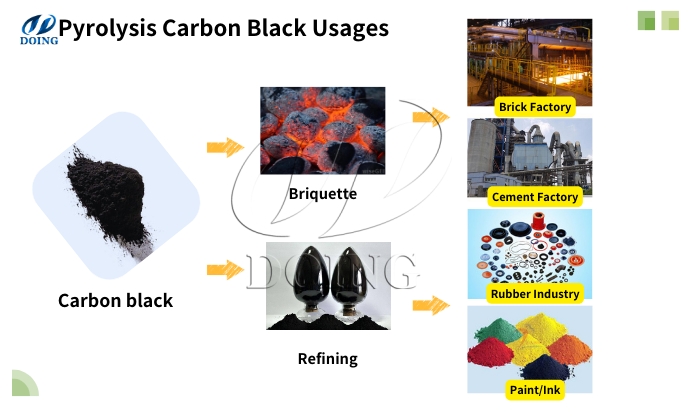 Pyrolysis carbon black applications
C. Sustainable Biochar (From Biomass Pyrolysis): When processing organic materials like wood chips, coconut shells, palm kernel shells, or agricultural waste, the primary solid residue is Biochar.
Commercial Value of Biochar:
Soil Amendment & Regeneration: Its highly porous structure retains moisture, fixes nutrients, and enhances agricultural soil fertility.
Carbon Sequestration & Carbon Credits: Biochar locks carbon into a solid form for centuries, making it an eligible asset for highly lucrative international carbon credit trading markets.
Solid Green Fuel: Features high energy density, acting as an eco-friendly replacement for coal in industrial boilers.
D. Steel Wire (12% - 15% Yield)
Extracted prior to or after the pyrolysis cycle, this high-tensile steel wire can be sold directly to scrap metal recycling markets or steel mills for smelting and re-manufacturing.
6. Environmental Compliance and Emission Controls
A primary bottleneck in getting global project approval for a pyrolysis factory is environmental scrutiny. Modern engineering must address flue gas and odor emissions. Doing Group Pyrolysis Plants incorporate a sophisticated multi-tier environmental protection system:
Flue Gas Scrubbing: The flue gas generated from heating the reactor undergoes desulfurization, water spraying, and activated carbon adsorption to ensure compliance with strict regional standards, such as EU standards or US EPA guidelines.
 ISO and CE- certification of DOING pyrolysis plant
Zero Wastewater Discharge: The cooling water flows through a closed-loop recycling mechanism, achieving zero industrial wastewater discharge.
Odor Mitigation: Specialized water seals and gas filters neutralize volatile organic compounds(VOCs) before the syngas is fed back into the combustion system, ensuring an odor-free workshop environment.
7. Project Cost and ROI (Return on Investment) Estimation
Is a pyrolysis plant profitable? Below is a generic daily economic feasibility assessment based on a DY-10Ton Model Batch Waste Tyre Pyrolysis Plant configuration:
Daily Financial Equation: Net Profit = Total Product Revenue - (Raw Material Cost + Operational Overhead)Note: The financial data provided above is an estimation based on regional averages. Actual market prices of scrap tyres and fuel oil fluctuate based on local geographical metrics and crude oil pricing trends.
| Expense/Revenue Stream | Calculation Base | Estimated Revenue(USD) |
| Raw Material Cost | 10 Tons of Waste Tyres * $40/Ton | -$400 |
| Overhead Expenses | Electricity, Water, Heating Fuel & 3 Operators | -$250 |
| Pyrolysis Oil Revenue | 4.5 Tons of Fuel Oil * $450/Ton | +$2,025 |
| Carbon Black Revenue | 3 Tons of Carbon Black *$70/Ton | +$210 |
| Steel Wire Revenue | 1.2 Tons of Steel Wire * $150/Ton | +$180 |
| Net Daily Profit | ($2,025 + $210 + $180) - ($400 + $250) | +$1,765 / Day |
Partnering with Doing Group for Sustainable Pyrolysis Plant Investment Success
Investing in a pyrolysis plant is a highly lucrative venture that masterfully bridges environmental preservation with high-yielding financial returns. It's more and more pupular in waste treatment and fuel oil regeneration applications. However, equipment reliability, safety systems, and thermal efficiency are critical differentiators between project success and failure.
 Pyrolysis plant project cases in some countries
As a leading global manufacturer of thermal pyrolysis plant machinery with more than 15+ Years Experience, Doing Group provides customized batch, semi-continuous and fully continuous pyrolysis plants equipped with industrial-scale condenser systems and advanced environmental control modules. Our pyrolysis plant solutions empower you to convert industrial waste into clean fuel energy efficiently and compliantly.